LinqTV Blog
HESP vs HLS vs MPEG DASH: Which One is Best For Your Live Streaming Business
In this blog, we compared HESP vs HLS vs MPEG DASH to see how they perform under different parameters, and which one will suit your business more and why.
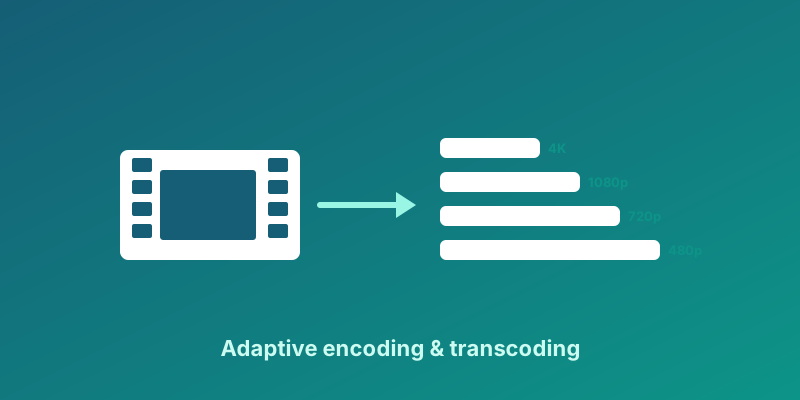
This page breaks down Hesp VS HLS Mpeg Dash Comparing Live for streaming and media teams: the core idea, the practical workflow, and the decisions that affect cost and viewer experience.
What Hesp VS HLS Mpeg Dash Comparing Live really means
Hesp VS HLS Mpeg Dash Comparing Live compresses source video into efficient formats and bitrates for smooth streaming. In streaming terms, encoding and packaging sits at the center of how audiences discover, watch and pay for your content.
Why it matters
- HDR, 4K and high-frame-rate support where devices allow
- HLS and DASH packaging from a single mezzanine file
- Captions, multi-audio and thumbnail-track generation
- Adaptive bitrate ladders in H.264, HEVC and AV1
- Per-title and content-aware encoding to cut bandwidth cost
What happens under the hood
Per-title and content-aware encoding analyze each video to assign just enough bitrate for the quality target, cutting delivery cost without visible quality loss.
A source is decoded then re-encoded with a codec such as H.264, HEVC or AV1 into a ladder of resolutions and bitrates, and packaged into HLS and DASH so any player can pick the best rung for current bandwidth.
The LinqTV approach
LinqTV transcodes your sources into adaptive H.264, HEVC and AV1 ladders and packages HLS and DASH automatically, with per-title encoding to control cost.
Because every module shares identity, billing, metadata and analytics, you avoid brittle point-to-point integrations and ship new features faster.
Common questions
Does it work for both live and on-demand?
Yes. The platform supports live events, on-demand catalogs, audio and linear channels with shared identity, billing and analytics.
What is adaptive bitrate streaming?
It packages several quality renditions and lets the player switch between them on the fly based on bandwidth, keeping playback smooth as connections change.
Where to go from here
Ready to put encoding and packaging to work? Explore LinqTV One for an end-to-end streaming platform, or talk to our team for a tailored walkthrough of how Hesp VS HLS Mpeg Dash Comparing Live fits your roadmap. The links below are a good place to start.
Explore more on LinqTV